
The Edge Effect: Five Animators Who Redrew the Boundaries Between Celluloid and Fine Art
Updated: Jun 8
Prologue: How One Artbook Changed a Life
Mai Yoneyama's story begins with an artbook. In the drafting room of an architectural high school in Nagano Prefecture, where she should have been focused on drawing boards and building measurements, she stumbled upon an animator illustration collection titled edge. It was a revelatory moment — the book featured works by animators Kenichi Yoshida, Hiroyuki Imaishi, Yoh Yoshinari, Tatsuyuki Tanaka, and Toshio Ishizaki. The force of their linework, the precision of their figure drawing, and the explosive dynamism of their compositions made her realise for the first time: animator illustrations could achieve such heights of artistic excellence.

That artbook was like a key, opening a door she never knew existed. She became obsessed with Mamoru Oshii's Patlabor 2 and Ghost in the Shell, captivated by the figure drawing of Kazuchika Kise, Shinya Ohira, and Tsutomu Shibayama. What she didn't know then was that certain artists in that book — Kenichi Yoshida and Toshio Ishizaki — would become deeply intertwined with her own life. Yoshida's Eureka Seven character designs would become one of her favourite works years later, while Ishizaki would end up as her colleague and friend in a Tokyo animation studio.

Yoneyama's story is not an isolated one. Behind that artbook named edge lies an entire aesthetic map — one connecting five visual artists from different generations, paths, and styles. All are intricately linked to Japan's animation industry: some emerged from animation studios, some devoted themselves to animation creation, others freely traverse the space between animation and fine art. Together they compose a collective portrait of Japanese animation's visual aesthetics, proving a simple yet often overlooked truth: animation has never been merely 'sequential images' — it is an independent and complete visual art form.
I. The Founder: Yoshiyuki Sadamoto — The Genesis Aesthetic of Gainax

To understand the starting point of this aesthetic map, we must return to Yamaguchi Prefecture in 1962. There, Yoshiyuki Sadamoto was born, and would go on to co-found the animation studio Gainax in 1984 alongside Hideaki Anno, Toshio Okada, Hiroyuki Yamaga, Mahiro Maeda, and Yasuhiro Takeda. Before that, they were university students united by a passion for animation, who stunned the entire Japanese animation world with their self-produced Daicon III and Daicon IV opening animations — those shorts, bursting with astonishing energy, fully demonstrated the unmatched talent and fervour of these young creators.

Sadamoto's character design style is singular in Japanese animation. His figures are not simply 'beautiful types' but psychologically complex individuals. In Neon Genesis Evangelion, his designs for Shinji Ikari, Rei Ayanami, Asuka Langley Soryu, and nearly all characters became among the most recognisable images in global popular culture. His linework is precise yet not cold; his characters' expressions often carry a maturity disproportionate to their age, which is precisely the source of his work's appeal.

In FLCL, he created even more forceful and dynamic characters, that wild drawing style forming a vivid contrast with Evangelion's austerity, demonstrating his versatility as a visual artist.

“My character design always starts from "people," not from "types." I care more about their inner worlds than their appearances.”
Sadamoto's influence extends far beyond animation. His long-term collaboration with director Mamoru Hosoda is itself a celebrated partnership — from The Girl Who Leapt Through Time to Summer Wars, to Wolf Children, he has been Hosoda's undisputed first choice for character design. His wife is manga artist Mako Takaha, and this 'artistic household' atmosphere imbues his creation with keen observation of daily life and warmth. Although he announced his separation from Gainax after Evangelion's conclusion, his influence has already been deeply encoded into Japanese animation's DNA.
II. The Awakener: Kenichi Yoshida — A Generation's Aesthetic Awakening

Among the names in the artbook that shook Mai Yoneyama, Kenichi Yoshida holds a special place. Born in 1969 in Kumamoto Prefecture, he joined Studio Ghibli after graduation in 1990, spending nine formative years there. Ghibli's legendary work ethic was gruelling, but Yoshida underwent rigorous training there, mastering the core techniques of figure drawing — precisely what moved Yoneyama when she encountered his work in the edge collection. Yoshida's figures are not merely 'beautiful' but real — he can construct a complete, flesh-and-blood character with just a few precise strokes.

In 1999, Yoshida left Ghibli to join the production of the TV anime Eureka Seven as character designer. This work became the milestone of his career — his designs for Renton Thurston and Eureka, along with the entire character roster, are considered a landmark in Japanese TV animation character design. Yoshida's aesthetic was not the typical 'moe' style of Japanese anime but rather Asian figures with a strong European illustration influence. Those characters' faces were not standard anime pretty boys and girls but 'people' with distinct individual features — they had noses, bone structure, and a sense of bodily weight.

“My character design philosophy is to give everyone their own face, not to carve them all from the same mould.”
In 2006, Yoshida won the Japan SF Seiun Award for his Eureka Seven character designs. This prize was the ultimate affirmation of his 'breaking the conventions of Japanese animation character design.' He went on to work on Overman King Gainer, Gundam Reconguista in G, and other projects, and will serve as character designer and chief animation director for the upcoming A Witch's Life in Mongol in 2026. For Mai Yoneyama, Kenichi Yoshida was not merely a name in the edge artbook but the awakener of her aesthetic consciousness — living proof that an animator's illustrations could reach the heights of art.
III. The Comrade: Toshio Ishizaki (Sushio) — The Wild Soul of Trigger

Another name appearing alongside Kenichi in the edge artbook is Toshio Ishizaki. Born in 1976 in Wakō, Saitama Prefecture, he worked under his real name until 2001, when he adopted the pen name Sushio. Like Yoshida, he emerged from Gainax, and in 2011 joined the newly established animation studio Trigger alongside Hiroyuki Imaishi, Atsushi Nishigori, and others. There, he served as character designer for Kill la Kill, which became one of Trigger's signature works and made Sushio's name known to animation fans worldwide.
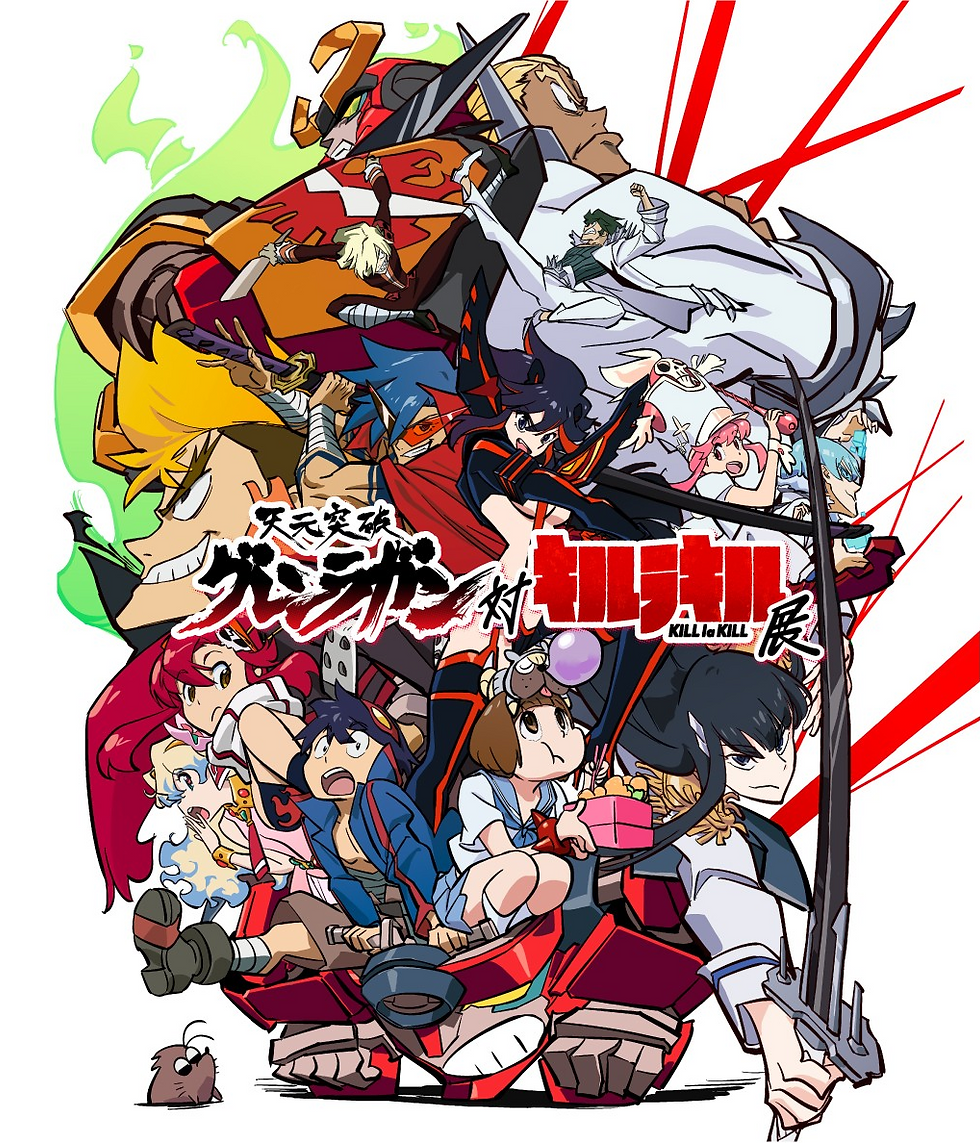
Sushio's drawing style is renowned for its 'wildness.' His lines pulse with energy and dynamism, and his character designs emphasise the body's tension and emotional explosiveness. His work does not pursue the refinement and elegance of traditional Japanese animation but instead strikes viewers with a raw, almost brutal sense of force. His strokes are powerful, and his figures always appear in extreme motion, as if every frame were an independent painting. This style contrasts sharply with his colleague Mai Yoneyama: while her work is tender and serene, emphasising detail and chromatic layering, Sushio's is explosive, prioritising raw power and direct emotional expression.

“I want to create images that make people jump out of their seats, not images that make people sit quietly and contemplate.”
The relationship between Sushio and Yoneyama is particularly nuanced. Both emerged from Gainax, both moved to Trigger, both worked on Kill la Kill — yet their artistic paths diverged dramatically. Yoneyama chose to become an independent illustrator in 2018, pursuing personal expression, while Sushio remained at the core of the animation industry, continuing to create as a character designer. They represent two possibilities for an animator's transition: one path leads to independent art, the other continues creating within the industrial system. Both are valid; each has its own value.
IV. The Maverick: Range Murata — Art Nouveau Incarnate in Animation

Born in Osaka in 1968, Range Murata is roughly the same age as Yoshiyuki Sadamoto, yet their aesthetic paths could not be more different. Sadamoto's world is one of cold machinery and psychological plunder; Murata's is a realm where retro luxury intertwines with steampunk intricacy. His character design fuses the flowing curves of Art Nouveau, the metallic textures of dieselpunk, and the 'moe' elements unique to Japanese animation, creating a visual style impossible to replicate elsewhere.

Murata's creative career began in 1993 with character designs for Atlus's fighting game Power Instinct series. In 1996, he left the gaming industry to become a freelance illustrator. His most widely known animation works are the character designs for Last Exile (2003) and Blue Submarine No. 6 (1998). In these works, he created retro-futuristic visual worlds where characters wear meticulous uniforms, pilot steam-powered machinery, and inhabit fantastical eras reminiscent of the World Wars.

Yet Murata's most unique contribution extends beyond his own works. In 1999, he founded the full-colour illustration magazine FLAT, winning the 34th Japan Book Design Award. In 2003, he launched the Robot magazine series, dedicated to discovering and promoting emerging artists. In an interview, he stated: 'I created Robot so that mainstream audiences could have the opportunity to recognise these new artists and be exposed to the worlds they create.' This sense of mission to 'discover new talent' makes Murata not merely an artist but an aesthetic evangelist — he is scouting the next gen of Japanese animation's visual artists.

“By publishing Robot, I thought I could influence other publishers to start similar projects that would seek out the next up-and-coming artist.”
The connection between Murata and Yoneyama is particularly intriguing. In 2024, they served together as judges for the Next ILLUST Award. On the jury of this international illustration competition sat a veteran who has influenced the animation world with his Art Nouveau style for nearly two decades, alongside a rising star who had just left her animation studio and was stunning the world with river-like flows of colour and light. Their shared panel symbolises the transmission and transformation of Japanese animation's visual aesthetics — Murata representing the traditional elite's cultivation of new talent, Yoneyama representing the new generation's push against aesthetic boundaries.
Epilogue: The Visual Legacy Beyond Celluloid
Reviewing the trajectories of these five artists, a panoramic view of Japanese animation's visual aesthetics gradually comes into focus. From Yoshiyuki Sadamoto, born in 1962, to Mai Yoneyama, born in 1988 — a span of 26 years; from Gainax's founding to Trigger's rise, from hand-painted cel to digital creation, from Tokyo to New York — their stories interweave into a contemporary history of 'how animation became art.'

Subtle yet real connections exist among these five artists: Sadamoto is the founder of Gainax's aesthetic, his influence continuing through the studio's legacy to this day; Kenichi Yoshida's Eureka Seven altered Mai Yoneyama's life trajectory, making her aware of the highest reaches of animation illustration; Toshio Ishizaki (Sushio) fought alongside Yoneyama at Trigger, demonstrating two radically different aesthetic paths under the same roof; Range Murata sat on the jury with Yoneyama two decades later, completing the circle of aesthetic transmission. One artbook named edge intertwined their destinies.

“Animation is not merely sequential images; it is a complete visual art. Every animator is a potential visual artist.”
For you reading this article — whether an animation enthusiast, an art practitioner, or simply someone curious about 'beauty' — the stories of these five artists may offer some revelation. They tell us: the boundaries of art are never fixed, and the destination of animation is not merely the silver screen. From cel to canvas, from screen to gallery, from industrial system to personal expression — this path has always been there, awaiting every soul willing to walk it. Just as Mai Yoneyama discovered in that edge artbook that changed her life: sometimes, all it takes to change everything is a serendipitous encounter.
FOR EXHIBITED ART WORKS © ALL RIGHTS RESERVED BY THE ARTIST


Comments