

Yukiko Noritake, Japanese illustrator who abandoned corporate spreadsheets for Parisian artistry, transmutes childhood scrap-paper passion into acrylic-digital duality, bridging cultures through vibrant multilingual children's books and international campaigns with elegant calligraphic resonance.

YooshiQ's Note
About this artist
Yukiko Noritake’s artistic journey is one of serendipity and self-discovery. Born in Japan in 1989, the Paris-based illustrator and acrylic painter has carved a niche as a globally celebrated artist, blending the precision of Japanese aesthetics with the romantic spontaneity of French artistry. Her work—vibrant, emotive, and often tinged with narrative whimsy—has graced international campaigns, magazines, and children’s books, cementing her as a bridge between cultures.
Noritake’s affinity for art began in childhood. “I drew so much that my mom had to stop buying sketchbooks and collect scrap paper—calendars, flyers, anything,” she recalls, laughing. This early passion lay dormant during her years in a corporate Japanese job, until a transformative stint at Paris’s École de Condé reignited her creative spark. She stayed in France, trading spreadsheets for brushes, and never looked back.
Today, Noritake’s acrylic paintings are distinguished by their textured brushwork and digital refinement. She layers strokes on heavyweight paper, later enhancing hues digitally—a process mirroring her dual identity. “I create emotion through contrasts: soft and bold, traditional and modern,” she explains. Her portfolio spans commercial collaborations and deeply personal projects, including *Forêt des frères*, a children’s book published in multiple languages—a milestone she calls “a proud, unforgettable moment.”
When pressed to name a favorite work, she hesitates. “My style evolves; so do my favorites.” Currently, two pieces stand out: a sweeping Californian landscape inspired by the film *Marriage Story* (“I had to recreate its epic beauty”) and a portrait of a friend in Provence. The latter, she admits, took creative liberties: “Her dress was floral, so I wove blossoms into the scene. The real house was simpler—but art isn’t about replication.”
Life in Paris has shaped her practice, yet Japan remains a visceral touchstone. She misses the cuisine most: “I stockpile dashi and miso—they’re lifelines.” While French gastronomy enchants her, she jokes that her pantry is “a mini-Tokyo.” Professionally, she credits French materials and training, but her artistry’s elegance, she notes, is rooted in Japanese calligraphy’s disciplined grace.
Career highlights include joining two creative agencies last year, broadening her clientele, and the global success of her book. Yet Noritake’s ethos remains grounded in balance—wellbeing via ritual, whether crafting miso soup or diffusing essential oils, which she cites as both muse and balm.
At 34, Yukiko Noritake embodies a harmonious duality: a global citizen whose art whispers of home, wherever that may be. As she paints futures yet unseen, one truth endures—her work, like her journey, is a testament to daring reinvention.


Intérieurs Imaginaires was Yukiko Noritake's solo at Galerie Virginie Lesage, Paris, 18 June to 4 July. Acrylic rooms built like interiors: Art Deco, a 1960s line, and a Japanese accent, with animals turning up inside the architecture.
If you like this artist, you may also like

Tono
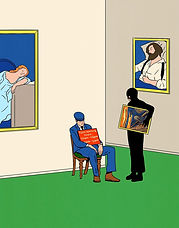
Simon Bailly
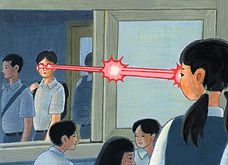
Kamiya Shunpei

Eve Liu
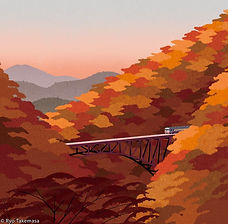
Ryo Takemasa
Share this artist via
Explore other artists from the index


FOR EXHIBITED ART WORKS © ALL RIGHTS RESERVED BY THE ARTIST
© 2026 BY YOOSHIQ VISUALS